Veretenniki
Doctor ZhivagoVeretenniki is remembered both as a village where Pelagia Tiagunova briefly found happiness among Vasia’s family and as a community that drove her away. Its later reported destruction by reprisal for withholding food turns that fragile refuge into a sign of how war and scarcity reach into village life, destroying homes and scattering the people connected to them.
A Brief Refuge
Pelagia’s account of the past two years places Veretenniki among the unsettled stops of her wartime life. After sharing a railway carriage with Vasia, a handsome, unspoiled boy who had been unlawfully conscripted, she stayed with his mother in the village. She says she was very happy there, but that happiness depended on a welcome the village did not sustain.
The villagers treated Pelagia as an outsider and falsely accused her of having a love affair with Vasia. The accusation turned her presence into a source of communal hostility: she eventually had to leave to avoid being pecked to death. Her departure was not a free choice between homes but an escape from a social environment that had made continued residence dangerous.
Reprisal and Ruin
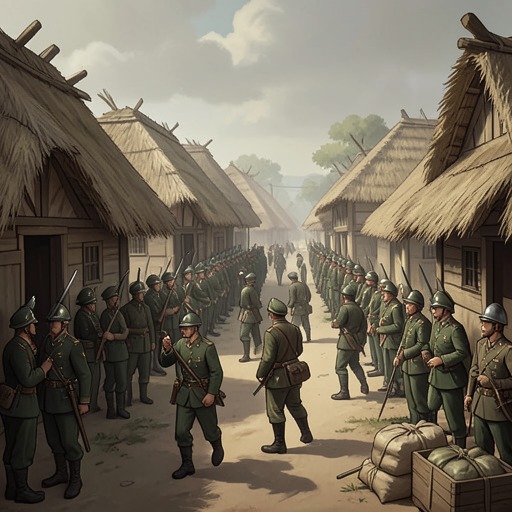
By the time Pelagia recounts her story, misfortune has overtaken the people she knew in Veretenniki. The village had been raided in reprisal for withholding food supplies. Rumor said that Vasia’s house had been burned and that one member of his family had perished; the account preserves uncertainty about the victim’s identity and presents the house’s destruction and the death as reported news rather than events witnessed by Pelagia.
The contrast between Pelagia’s earlier happiness and the later reports is stark. The village that had briefly sheltered her is now associated with collective punishment and bereavement. Vasia’s unlawful conscription had already made the household vulnerable to separation; the raid extends that vulnerability to the home itself and leaves the surviving family’s circumstances uncertain.
Place in Pelagia’s Displacement
Veretenniki is one link in Pelagia’s sequence of precarious settlements. After leaving, she went to her married sister, Olga Galuzina, in Krestovozdvizhensk. Rumors that Prokhor Prituliev had been seen nearby then drew her to Pazhinsk, but the reports proved false, leaving her stranded there until she found work. Her recollection thus connects Veretenniki’s local hostility to a wider pattern of forced movement, unreliable news, and unstable refuge.
The village’s significance lies in this double memory: Pelagia was happy there, yet could not remain, and the family she had stayed with was later caught in violence over food supplies. Veretenniki is not presented through a sustained description of its landscape or institutions; it emerges through the consequences borne by its residents and by the woman who had briefly lived among them.